
Free written scope consultation - allowances, timeline, and change-order rules on paper before a single trade is scheduled
Tuff Shed Driveway & Pavers: The Orange County Owner’s Guide
If the driveway or paver base under your Tuff Shed has shifted, sunk, or cracked, we stock Tuff Shed-compatible paver driveway materials and install them throughout Orange County. A paver driveway installation in Orange County typically runs $7,000 – $18,000 depending on square footage, soil condition, and the paver line you choose, and most jobs are completed in three to five working days. What we see most often: an owner notices the shed’s double doors starting to drag against the pad, or a corner of the shed has settled a half-inch so water pools at the threshold after rain. That’s not a Tuff Shed frame problem. It’s what’s underneath it.
Your shed floor bears the load of whatever you keep inside: mowers, generators, tool chests, half a pallet of bagged concrete that seemed like a good idea in 2019. When the pavers underneath heave or separate, the shed racks slightly, the doors bind, and you start seeing daylight at the floor seam. We see it across Irvine, Mission Viejo, Santa Ana, and Fountain Valley, and the fix is usually more straightforward than people fear.
A quick note on who we are: Penhallow Remodeling Orange County is an independent service provider. We’re not affiliated with Tuff Shed, but we’ve installed and repaired paver bases under Tuff Sheds for years, and we know the load points and threshold details that matter on their Premier, Pro, and Sundance series buildings.
Which Tuff Shed Models This Applies To
Every Tuff Shed model from a compact 8×8 Sundance up to a 16×36 Premier Pro relies on the same thing from the ground up: a level, stable, load-bearing surface. The difference is scale. A Sundance series sitting on a 10×10 paver pad puts around 40 to 60 pounds per square foot on the pavers. A Premier Pro with a loft, heavy workbench, and stacked storage can push well past that, and weak edges fail first.
The compatibility piece that actually matters isn’t the shed model; it’s the pad dimensions and the perimeter detail. Tuff Shed floor frames are typically built with 2×4 or 2×6 pressure-treated skids that run the full length of the building. Pavers need to extend at least 6 inches beyond the skid line on all four sides. When the pad ends flush with the shed wall, the outer skid sits half-supported, and the pavers at the unsupported edge start to tip outward within the first two wet seasons. In Orange County, where clay-heavy soils in older neighborhoods near the Spectrum expand and contract noticeably with winter rains and summer drought, that edge-loading gets much worse than it does in sandy coastal areas.
For OEM versus aftermarket: Tuff Shed doesn’t manufacture pavers, and their recommended base is general-use paver material. What we stock and install for Tuff Shed pads are the same trade paver lines the company and every competent installer specifies: Belgard and Unilock, both of which carry manufacturer warranties on top of our workmanship guarantee. This is one product where “OEM” isn’t a thing, and aftermarket quality is the whole conversation. The real compatibility check is paver thickness. Under a shed with regular foot traffic and equipment load, we use 2-3/8-inch-thick pavers, not the 1-3/4-inch pedestrian grade some builders use on garden paths. The thinner stuff will crack at the threshold within a couple of years.
Styles & brands we work with







Signs Your Tuff Shed Driveway & Pavers Is Failing
- Shed doors drag or won’t latch. The floor frame was installed level, but the pad has settled unevenly, usually at the front threshold where rain splashes and saturates the base. The door reveal shrinks at one corner. We fix level, not just the pavers.
- Water pools at the shed entrance after rain. This is the most common complaint in Orange County after a wet winter. A low spot means the base compacted unevenly. The water sitting at the threshold wicks into the shed wall bottom plate and starts rusting door hardware and rotting the trim line.
- Paver edges along the shed perimeter are tipping outward. The edge restraint wasn’t installed or wasn’t deep enough. Without a solid edge restraint, the outer pavers lose lateral support the moment the ground gets wet and expands. The fix is lifting the edge rows, installing a proper restraint, and recompacting.
- You can see gaps opening between pavers. In clay soil areas like north Irvine and parts of Tustin, pavers separate as the ground shrinks in summer drought. The gaps widen, sand washes out, and the pavers begin to rock underfoot. Left alone, the rocking wears the edges and the problem spreads inward.
- The shed floor bounces when you walk across it. You feel spring underfoot. That means one or more skids have lost contact with the pad below, creating voids. The shed wasn’t built to span a gap, and over time that bounce stress-cracks floor decking and loosens wall fasteners.
See the difference
 Before
 After
After Before
 After
After Before
 After
AfterReplacement Cost & What’s Included
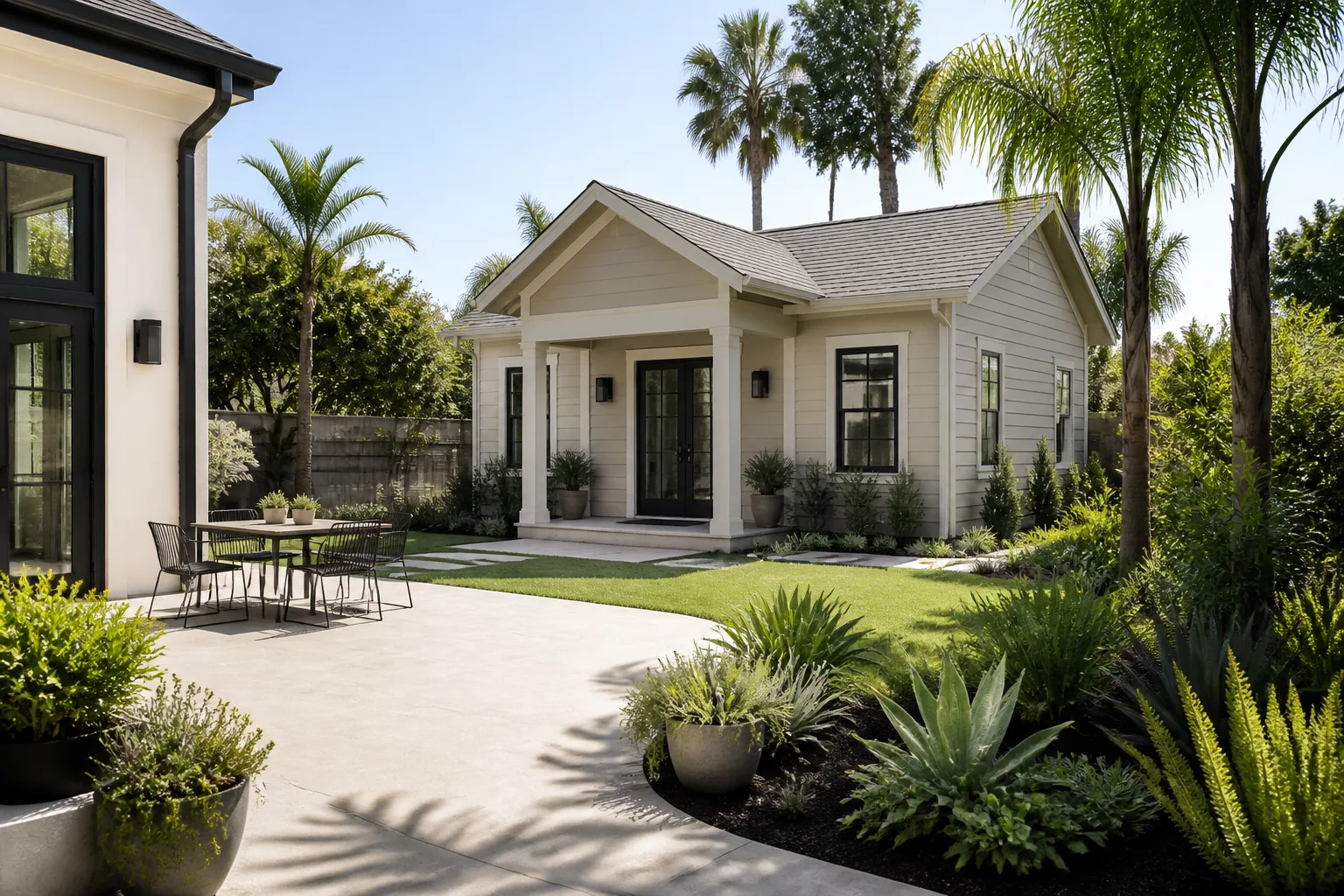
Paver driveway installation in Orange County runs $7,000 – $18,000. The range is driven by square footage first, then by what’s underneath. If you’re putting in a pad for a Tuff Shed only, count on the lower half of that range. If the pavers double as the driveway leading to the shed, or the pad replaces failing concrete instead of going over open ground, the number climbs.
Here’s the line-item picture for a typical 12×20 Tuff Shed pad in Orange County on open ground:
- Site prep, excavation, and grading: $900 – $1,800
- Compacted aggregate base (4 to 6 inches of Class II road base): $1,200 – $2,400
- Paver material (Belgard or Unilock, 2-3/8 inch): $2,800 – $5,500
- Edge restraint, sand, and final compaction: $600 – $1,100
- Labor and equipment: $2,500 – $4,500
We include the written price up front, and the number on day one is the number on the invoice. If the base needs more stone than we quote because the soil is worse than expected, we eat that difference, not you. Every paver installation carries our 365-Day Done Right Promise in writing: if the pavers shift, sink, or fail within a year, we come back and fix it at no charge. And if a section fails after the guarantee period, we still show up for a free second visit to look at it before quoting any repair.
DIY or Call Us?
There are things you can safely check yourself. Measure the gap between your shed doors at the top and bottom to see if the racking is consistent. Walk the pad and mark any paver that rocks or feels soft underfoot. Look for edge restraint that’s separated or missing anywhere around the perimeter, especially at corners.
What you shouldn’t do is start lifting and re-laying pavers under a loaded shed. When you pull pavers from under a skid line, the shed’s floor frame loses support in that zone, and if the building is even slightly out of level, the wall can rack enough to pop fasteners or jam the doors hard. The base prep under a shed isn’t like a patio: you’re working in tight space against existing structure, and if the compaction isn’t right, the pad moves again inside a season. This is a job where the prep and the compaction matter more than the pretty part on top. If you see early signs like a wet threshold or a dragging door, call us at (424) 541-1701 and we’ll walk you through what we’re seeing before anyone touches a shovel.
FAQs
A properly installed paver base under a Tuff Shed in Orange County lasts 25 to 40 years with almost no maintenance. The catch is the base and the edge restraint. Pavers themselves don’t fail; the ground under them does. On clay-dominant soil, which covers much of inland Orange County, expect minor settling after the first heavy rainy season even on a good install. That’s normal, and it’s why we put the guarantee in writing.
Yes, in most cases. If the perimeter edges are tipping but the field is solid, we lift the edge rows, install a proper restraint, recompact, and relay. If the pad has sunk in one area, we pull that section, add base material, compact in lifts, and relay the pavers. Full replacement only makes sense when the base was never properly built, meaning no real stone underneath, just pavers on sand over dirt. Call (424) 541-1701 and we’ll tell you honestly which one you’re looking at.
For a pad under a shed that’s being repaired in place, plan on two to four working days depending on square footage and soil. For a full new installation with site prep for a new shed delivery, it’s three to five working days. Weather in Orange County rarely delays paver work, and we give you a real arrival window in writing before any day of work.
We stock Belgard and Unilock paver lines in the most common Orange County colors and sizes, and we bring the material for your job on our truck the day we start. You don’t need to order anything separately or coordinate delivery. If you want a specific color or texture that isn’t on the truck, we order it to the job and factor lead time into your written schedule, not into a surprise.
Written by Trevor Nash, Owner, Penhallow Remodeling Orange County at Penhallow Remodeling Orange County, serving Orange County and nearby areas.


