
Free written scope consultation - allowances, timeline, and change-order rules on paper before a single trade is scheduled
James Hardie Bathroom Remodeling: The Orange County Owner’s Guide
James Hardie bathroom remodeling in Orange County typically runs $9,000 – $28,000 installed, and in most cases we can begin work within two to three weeks of your written estimate. The biggest driver of cost is almost always substrate failure: James Hardie backer board installed poorly or against a wall that moves. Homeowners usually discover it the same way: cracked grout lines, a musty smell behind the vanity, or tile that sounds hollow when you tap it.
Here’s the part most contractor sites won’t tell you. James Hardie doesn’t make bathroom tile or fixtures. When we say “James Hardie bathroom remodeling,” we’re talking about the moisture barrier and substrate system behind the tile: HardieBacker cement board, James Hardie waterproofing products, and the joint treatment that keeps water from ever reaching your framing. Get that layer right in Orange County’s coastal humidity and the tile stays put for 30 years. Get it wrong, and a $9,000 bathroom turns into a $28,000 gut-and-rebuild.
We’re an independent Orange County remodeling contractor. We install James Hardie products, but we’re not affiliated with the manufacturer, and we’ll tell you honestly when a James Hardie product is the right call and when another spec works better for your walls.
Which James Hardie Models This Applies To
If you have an Orange County home built or remodeled in the last 20 years, your bathroom walls likely have one of three James Hardie substrates behind the tile:
- HardieBacker 500 – the standard half-inch cement board. Used on floors, walls, and countertops. Most common in shower surrounds and tub decks.
- HardieBacker 250 – thinner quarter-inch sheet, used on floors when you don’t want height buildup. Not for walls. We’ve pulled it out of walls a dozen times because someone grabbed the wrong sheet at the supply yard.
- James Hardie waterproofing membrane – a liquid-applied roll-on membrane used instead of sheet plastic behind tile. It bonds directly to the cement board to stop water vapor.
Compatibility matters more than you’d think. The 250 is not rated for vertical wall applications, and if your previous contractor used it behind shower tile, that’s a failure waiting. We also see homes where HardieBacker was installed directly over green board without a moisture barrier behind it. In Dana Point and Laguna Beach, where fog off the Pacific keeps walls damp nine months a year, that shortcut starts showing up as black grout lines within four years.
On the OEM-versus-aftermarket question: for substrate, we use James Hardie products almost exclusively. The warranty language is clear, the spec sheets are consistent, and when we need to match an existing wall section, the dimensions don’t drift. For the tile, fixtures, and trim, we source from the brands we trust with the Kingswell standard behind them: Kohler and Moen for fixtures, KraftMaid and Wellborn for vanities, Cambria and Silestone for solid surfaces. The James Hardie layer is the quiet part of the job, but it’s the layer that keeps everything else from rotting.
Styles & brands we work with







Signs Your James Hardie Bathroom Remodeling Is Failing
Here’s what we see most often in Orange County homes, and what it actually means behind the wall:
- Cracked grout lines that keep coming back – Your HardieBacker was probably installed without taped and mortared seams. Cement board expands and contracts with temperature swings, and unsealed seams let the tile assembly move independently. That’s why the same grout crack opens up every July.
- A musty smell behind the vanity or shower – Water is getting past the substrate layer. In most cases, the moisture barrier was never installed, or it was punctured with nail holes that weren’t sealed. By the time you smell it, the framing behind the board is likely damp.
- Tile that sounds hollow when tapped – Over time, cement board can start to separate from the studs if it was screwed instead of nailed with the right fasteners at the right spacing. James Hardie specifies fastener type, length, and spacing. Skip one spec and the bond loosens within a few seasons.
- Mold at the base of the shower curb – This is the classic Orange County coastal failure. Curb construction should be solid, wrapped in a waterproofing layer, then tiled. If the curb was framed with regular lumber and covered with only cement board and tile, water wicks up through the joints. Every shower that fails this way has to be torn out to the studs.
- Soft spots in the bathroom subfloor – If the original bathroom floor was tile over plywood without a HardieBacker layer, the plywood absorbs moisture from under the tile. In homes near the coast in Huntington Beach and Newport Beach, subfloor rot from missing cement board happens faster than in inland areas like Yorba Linda and Anaheim Hills. But it happens everywhere eventually.
See the difference
 Before
 After
After Before
 After
After Before
 After
AfterReplacement Cost & What’s Included
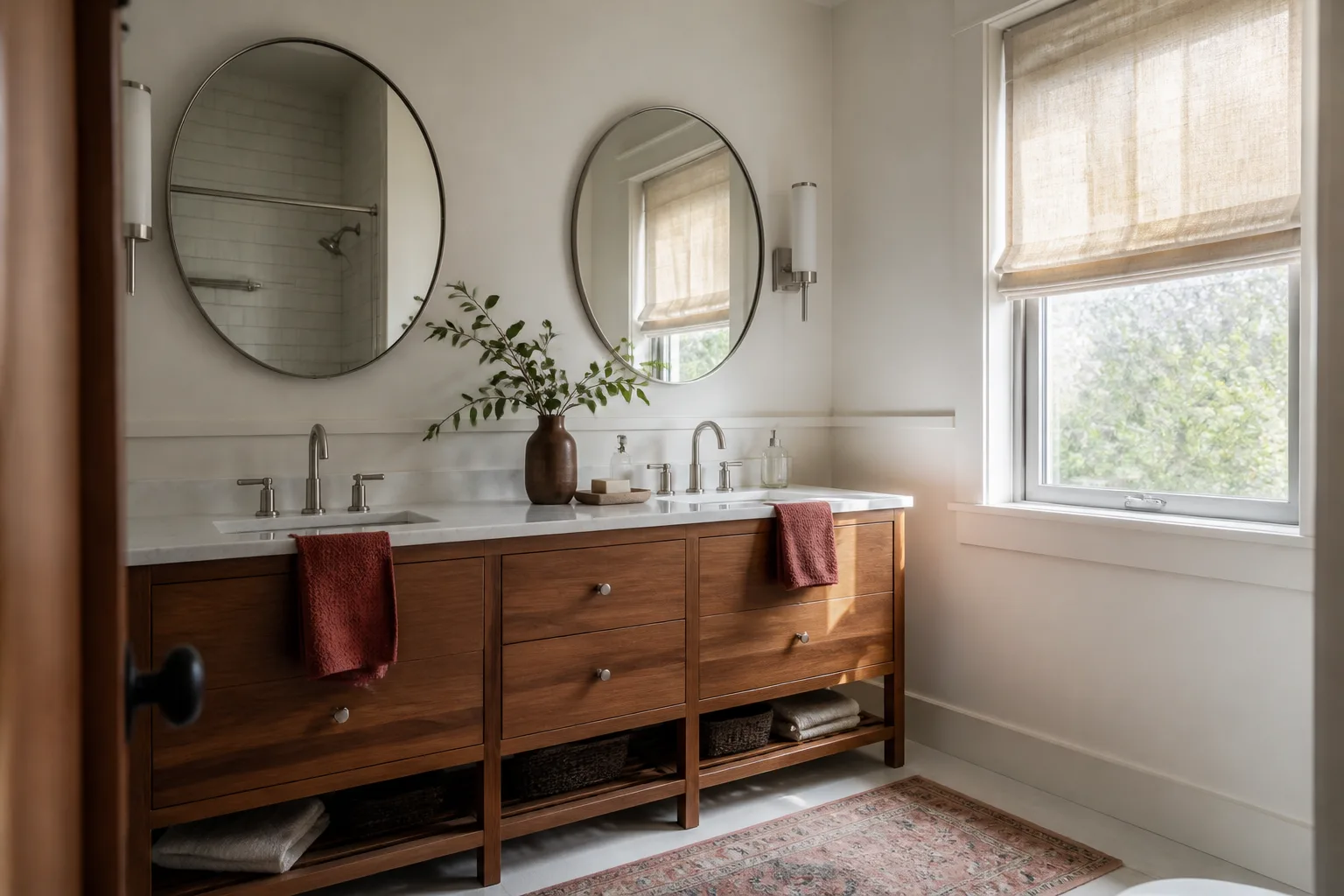
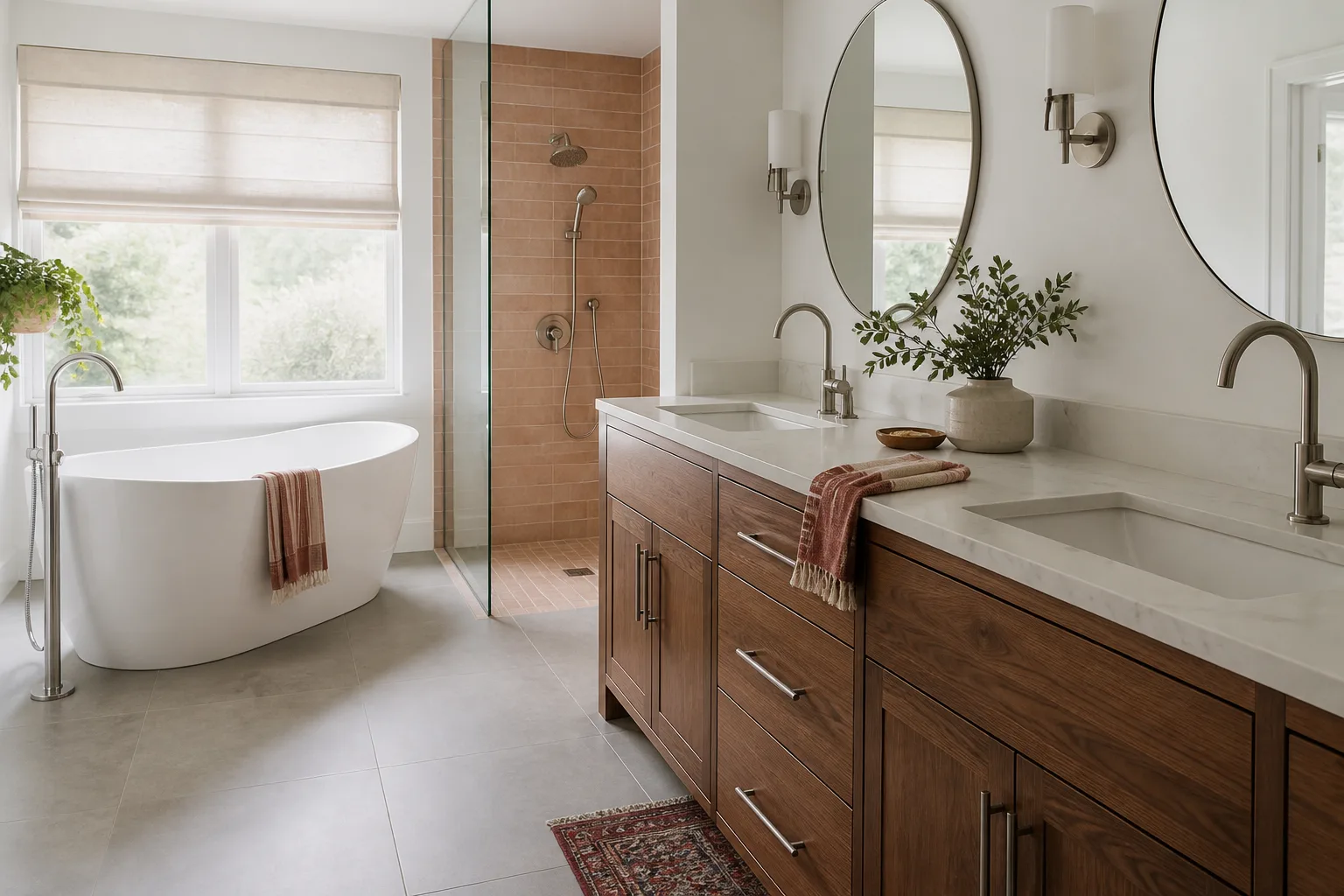
A full James Hardie bathroom remodel in Orange County runs $9,000 – $28,000. On the lower end, you’re looking at a small bathroom with a standard tub-to-shower conversion, basic white subway tile, and a single vanity. On the upper end, you’re moving walls, relocating plumbing, doing a walk-in shower with floor-to-ceiling tile, and adding a custom vanity with Cambria countertop. Most jobs land between $12,000 and $18,000.
What drives the number:
- Demolition and discovery – We budget for what’s behind the wall, because in Orange County we usually find something: rotted framing from a failed shower pan, old cast iron pipe, electrical that violates current code. When we write your number, we include the time to replace what’s actually there, not what we hope is there.
- Substrate scope – A full gut with new HardieBacker on every wall costs more than a tub surround refresh. But the gut is sometimes the cheaper long-term play, because we’re rebuilding to spec and you’re not paying twice later.
- Tile and finish selections – Subway tile runs $3 – $8 per square foot. Handmade or large-format porcelain runs $20 – $40. The substrate price doesn’t move; the tile choice changes the number meaningfully.
Every quote is a written number, not a range. We put it in writing before we pick up a tool, and that same number is on your invoice. The work is covered by our 365-Day Done Right Promise: if any part of the job fails inside the guarantee period, we come back and fix it at no charge. If a repair fails after we’ve touched it, the second visit is free, too.
DIY or Call Us?
You can safely do some things: check whether your grout is cracking more than it used to, inspect the caulk line around your tub or shower base, and look under the vanity for water staining. Those checks tell you whether you have a problem. They don’t tell you what’s behind the tile.
What we don’t recommend is pulling tile and replacing substrate yourself, especially in a shower or tub surround. The waterproofing layer is what keeps your bathroom from becoming a mold issue inside the walls, and there’s a reason James Hardie publishes detailed installation specs: a missed seam or a wrongly spaced fastener is invisible from the outside and silent for years. Once water gets behind the board, you’re not saving money, you’re scheduling a bigger remodel later. If you’ve got a failing bathroom and just want to know what you’re dealing with, call (424) 541-1701 and we’ll take a look. Give you the number first, then pick up the tool.
FAQs
A properly installed James Hardie substrate system should last 30+ years in Orange County conditions. The tile and grout on top may need sealer or regrouting every 8 – 12 years, but the structural layer shouldn’t fail. When it does, it’s almost always an installation error: missing moisture barrier, wrong board thickness, or seams that weren’t taped and mortared.
Sometimes. If the failure is isolated to one wall or the shower pan and the surrounding substrate is still sound, we can cut back the tile and replace that section with matching HardieBacker and new waterproofing. If the framing behind it has been wet for long, we’ll need to open further. We won’t know until we look. Call (424) 541-1701 for a free assessment and we’ll tell you what’s actually involved.
Most James Hardie bathroom remodels in Orange County run two to four weeks from demo to final fixture set. Larger jobs with moving walls or custom tile work can run five to six weeks. We give you a written schedule with the written price, and if something changes, you’ll know before demolition day.
We keep HardieBacker 500 and the matching fasteners, seam tape, and mortar on hand for every bathroom job. Specialized products like the James Hardie waterproofing membrane we order per project so the product isn’t sitting in a warehouse past its spec date. If you need a measurement we don’t carry in the truck, it’s typically a one-day turnaround from our supply house.
If your bathroom tile is cracking, your grout won’t stay sealed, or you can smell moisture behind the vanity, don’t wait until the framing rots. Call (424) 541-1701 for a free estimate. We’ll put a written number in your hand before any work starts, and we’ll stand behind it after the last tile is set.
Written by Trevor Nash, Owner, Penhallow Remodeling Orange County at Penhallow Remodeling Orange County, serving Orange County and nearby areas.


